- Themixtureremains workable for approx. 20 - 30
minutes (20°C).After approx. 6-8 hours (20°C) the bonded
parts may be moved, After 12 -16 hours (20°C) approx. they may be further processed. Maximal stability after 7 days(20°C).
- Toolscanbe cleaned with Nitro-Dilution.
- Thehardeningprocess is accelerated by heat and delayed by cold.
B.Cartridge System
1.Thoroughly clean and slightly roughen surfaces to be bonded.
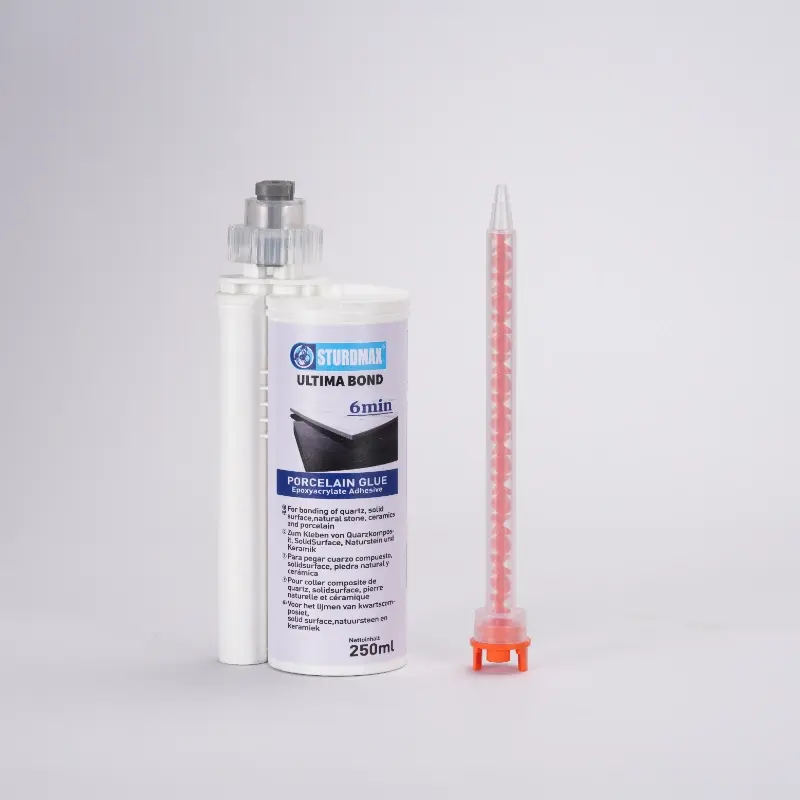
- Remove theclasp from the cartridge and put the cartridge in the gun; work the grip until material emerges from both openings; then eventually screw up the mixing nozzle.
3.STURDMAX® Colouring Pastes or Colouring Concentrates can be added up to max.5%.
- Bothcomponents must be thoroughly mixed when working without mixing nozzle.
- Themixtureremains workable for approx.20-30 minutes(20°C).After approx. 6 -8 hours (20°C) the bonded parts may be moved. After 12- 16 hours (20°C) approx. they may be further
processed. Maximal stability after 7 days(20°C).
- Toolscanbe cleaned with Nitro-Dilution.
- Thehardeningprocess is accelerated by heat and delayed by cold.
Special Notes:
- Suitable for bonding of load-bearing construction parts, however, the relevant standards such as DIN 18516 part 1 and part 3 or DIN 2304 must be observed during application.
- Only if the right mixing ratio is kept, optimal mechanical and chemical properties can be obtained. A surplus of adhesive or hardener has the effect of a softener and can cause
discolouration in the marginal zone.
- Single Mix cartridges are not suitable for compressed-air guns or guns with mechanical pistons.
- Two separate spatulas should be used for the adhesive and the hardener.
- An adhesive is no longer to be used if it has already thickened or is jellying.
- The product is not to be used at temperatures below 10°C because it will not sufficiently harden.
- At constant temperatures above 50°C the hardened adhesive tends to yellowing.
- The hardened adhesive can no longer be removed by means of solvents. This can only be achieved mechanically or by applying higher temperatures(>200°C).
- The A-component slightly tends to crystallize (honey effect). The product can be made workable again by warming it up.
- The stability of the bonding depends on the natural stone to be bonded: silicate-bound stone reacts better than carbonate-bound stone.
Technical Data:
1.Colour (A and B): transparent CC 2200
2.Density (A and B): approx.1.16 g/cm
3.Working time:
mixture of 100 g component A at 10℃: 60-70 minutes
+50 g of component B: at 20°C:20-30minutes
at 30°C:10-15 minutes
at 40°C:5-10minutes
- Mechanicalproperties:
Bending strength DIN EN ISO 178: 60-70N/mm2
Tensile strength DIN EN ISO 527: 30-40 N/mm2
5.Chemical Resistance:
Water absorption: <0.5%
Sodium Chloride Solution 10%: stable
Salt water: stable
Ammonium 10%: stable
Soda lye 10%: stable
Hydrochloric acid 10%: stable
Acetic acid 10%: conditionally stable
Formic acid 10%: conditionally stable
Petrol: stable
Diesel oil:stable
Lubricating oil:stable
- Hardeningprocess (Shore D hardness) of a 2 mm layer at 20°C:
4h/-- 5h/44 6h/67 7h/74 8h/76 24h/82 7d/83
Storage: If stored in dry and cool condition(5-25°C/41-77F) in its closed original container at least 24 months from production.
Health & Safety: Read Safety Data Sheet before handling or using this product.
Important Notice: The above information is based on the latest stage of development and
application technology. Due to a multiplicity of different influencing factors,this information - as
well as other oral or written technical advises - must be considered as non-binding hints. The user is obliged in each particular case to conduct performance tests, including but not limited to trails of the product, in an inconspicuous area or fabrication of a sample piece.