





Why Does Marble Glue Turn Yellow Over Time — And How to Prevent It
Release time: 2026-06-11
Table of Contents
Marble countertops and slabs rarely fail because the stone itself gives out — they fail at the seam. If you’ve ever walked past a once-flawless kitchen island and noticed a faint amber line creeping along the joint, you’ve seen what fabricators quietly dread: yellowing marble adhesive. It’s not just an aesthetic flaw. It signals a chemistry problem that, left unaddressed, undermines the entire installation.
What Actually Causes Marble Adhesive to Yellow
Yellowing isn’t random — it’s a predictable chemical reaction, and understanding it is the first step to preventing it.
- UV exposure breaks down resin bonds. Standard polyester-based adhesives contain styrene compounds that oxidize under sunlight, producing a visible amber discoloration within months of outdoor or sun-facing indoor use.
- Low-grade hardeners accelerate degradation. Off-ratio or impure catalysts cause uneven curing, leaving micro-pockets that oxidize faster than the surrounding bond line.
- Heat cycling stresses the polymer structure. Kitchen countertops near stovetops or sinks undergo repeated thermal expansion and contraction, which speeds up resin breakdown at the molecular level.
- Moisture trapped during application. If the stone surface isn’t fully dry before bonding, residual moisture reacts with the resin over time, contributing to discoloration from within the joint itself.
For light-colored marble — Carrara, Calacatta, Thassos white — this problem is magnified. There’s nowhere for yellowing to hide.
Why Marble Specifically Is More Vulnerable Than Other Stones
This is where many fabricators get the chemistry wrong. Marble’s calcite-based composition is more porous and reactive to chemical additives than engineered quartz or sintered stone. A formula that performs acceptably on darker granite can fail visibly on white marble because:
- Marble has higher light transmittance, so any tint shift in the adhesive is immediately visible through the stone’s surface.
- Calcite crystals can interact with acidic catalyst residues, subtly altering the cure color over months.
- Marble’s natural veining already draws the eye to seams — making any yellow tinge stand out more than on textured or speckled stones.
Epoxyacrylate vs Polyester Resin: A Side-by-Side Comparison
| Property | Standard Polyester Resin | Epoxyacrylate Adhesive |
| UV/anti-yellowing stability | Degrades within 6–18 months outdoors | Maintains clarity 12+ months, suited for long-term use |
| Working time at 25°C | Often under 2 minutes | 3–5 minutes, easier for precision joints |
| Full cure time | Varies widely, inconsistent | 3–5 hours, predictable |
| Suitability for light/white marble | Higher risk of visible discoloration | Engineered for transparency and color retention |
| Application range | Mostly indoor | Indoor and outdoor |
The takeaway: not all “clear” adhesives stay clear. The resin chemistry — not just the brand name on the bottle — determines whether a seam stays invisible in year one or turns into a liability by year three.
How to Prevent Yellowing Before It Starts
Prevention comes down to three controllable factors during fabrication:
- Choose resin chemistry built for anti-yellowing performance. Look for adhesives formulated with UV-stable epoxyacrylate rather than generic polyester blends, especially for light stone or outdoor-facing installations.
- Follow exact hardener ratios. Even a 1–2% deviation in catalyst proportion can shift cure color and long-term stability — always measure rather than eyeball.
- Ensure the bonding surface is completely dry and wax-free. Residual moisture or polishing compounds are a leading hidden cause of discoloration that fabricators often overlook.
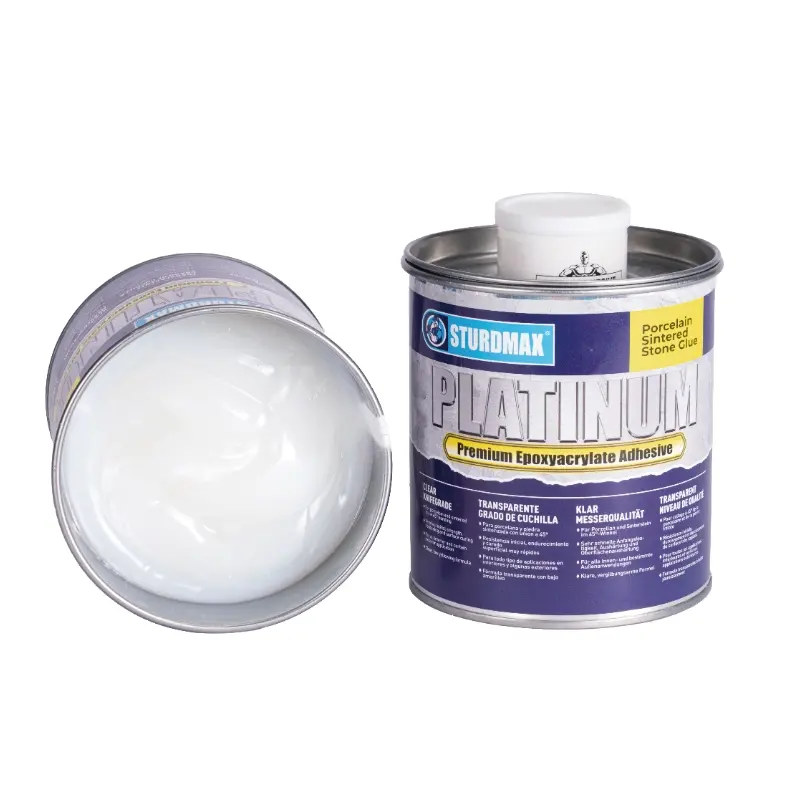
Products like the Platinum Epoxyacrylate Stone Adhesive are specifically engineered around this problem—combining transparent, non-yellowing resin chemistry with a fast 3–5 minute working time and full cure within hours, making it a practical option for fabricators working on white and light-toned marble.
A Note for Fabricators and Distributors
Stone fabrication businesses live and die by referrals — and nothing damages trust faster than a “permanent” installation that visibly ages within a year. Sourcing a stable, non-yellowing marble adhesive isn’t just a technical decision; it’s a reputation safeguard. Sturdmax has spent years refining epoxyacrylate formulations specifically for natural and engineered stone bonding, with consistent batch quality, documented technical data sheets, and export experience across global markets. For fabricators who can’t afford callbacks over discolored seams, working with a manufacturer that controls its own resin chemistry — rather than relying on generic formulas — makes the difference between a one-time sale and a long-term supplier relationship. Explore the full stone adhesive lineup or request a technical data sheet to compare performance before your next project.
FAQ
Does all marble glue eventually yellow?
Not necessarily. Yellowing is tied to resin chemistry, not an inevitable outcome — UV-stable epoxyacrylate formulas are specifically designed to resist the oxidation that causes discoloration in standard polyester adhesives.
Can yellowed marble adhesive be fixed without replacing the seam?
In most cases, no. Once oxidation has set into the cured resin, it’s a chemical change, not surface staining, so the affected adhesive typically needs to be removed and rebonded with a more stable formula.
Is epoxyacrylate better than epoxy resin for marble specifically?
For light and white marble, yes — epoxyacrylate generally offers better clarity retention and faster working times, though both fall under the broader marble adhesive category and should be matched to the specific stone color and application environment.
How long should a quality marble adhesive stay non-yellowing?
A well-formulated UV-stable product should maintain visual clarity for 12 months or longer under normal indoor and outdoor conditions, with proper hardener ratios and dry surface preparation.